MCU Products

MCU Products

Professional microcontroller solutions for your applications

Overview

The device is a Flash Memory 8-bit high performance RISC architecture microcontroller device with Continuous Glucose Monitoring (CGM) AFE module that specifically designed for CGM applications.

For memory features, the Flash Memory offers users the convenience of Flash Memory multi-programming features. Other memory includes an area of RAM Data Memory as well as an area of true EEPROM memory for storage of non-volatile data such as serial numbers, calibration data etc. By using the In Application Programming technology, users have a convenient means to directly store their measured data in the Flash Program Memory as well as having the ability to easily update their application programs.

Analog features include a multi-channel 24-bit Delta Sigma A/D converter, four 12-bit D/A converters, three internal operational amplifiers and one comparator. Multiple and extremely flexible Timer Modules provide timing, pulse generation and PWM generation functions. Communication with the outside world is catered for by including fully integrated SPI and UART interface functions, two popular interfaces which provide designers with a means of easy comminucation with external peripheral hardware. Protective features such as an internal Watchdog Timer and Low Voltage Reset coupled with excellent noise immunity and ESD protection ensure that reliable operation is maintained in hostile electrical environments.

A full choice of internal high and low oscillator functions are provided including fully integrated system oscillators which require no external components for their implementation. The ability to operate and switch dynamically between a range of operating modes using different clock sources gives users the ability to optimise microcontroller operation and minimise power consumption. With regard to CGM applications, the device has integrated many of the functions required by these products. These include functions such as Internal Reference Voltage generator, Internal LDO, 24-bit Delta Sigma A/D converter, 12-bit D/A Converters and operational amplifiers, etc. The inclusion of flexible I/O programming features, 16-bit MDU, 16-bit Cyclic Redundancy Check function, Time Base functions along with many other features enhance the versatility of the device to suit for CGM applications.

Features

High-Precision Bio-Sensing Analog Front-End

  • - Integrated 24-bit Delta-Sigma ADC
  • - Internal programmable OPAs and electrochemical measurement circuits
  • - Supports AC impedance, phase angle, and bio-signal sensing applications

Low Power Consumption and Wide Operating Voltage

  • - Operating voltage: 2.2V ~ 5.5V
  • - Supports selectable clock sources and power-down modes
  • - Ideal for battery-powered portable devices

Highly Integrated Memory and Interfaces

  • - Built-in Flash, RAM, and EEPROM
  • - Communication interfaces: I²C / SPI / UART
  • - Supports In-Application Programming (IAP) for firmware updates

Enhanced System Safety and Reliability

  • - Built-in Watchdog, LVR / LVD
  • - Strong noise immunity and ESD protection
  • - Flexible internal/external clock switching

Documents

BH66F2475v180

Contains electrical characteristics, register descriptions, and system architecture. Please refer to it before solution design and software development.

BH67F2475 Datasheet

QFN16

Includes package dimensions, pad layout, and assembly requirements. Please use it for PCB layout and process evaluation.

QFN24

Includes package dimensions, pad layout, and assembly requirements. Please use it for PCB layout and process evaluation.

BMHB2011 BH67F2475 BGM Dev Board Resources

Resources

BMHB2011 BH67F2475 BGM Dev Board Resources
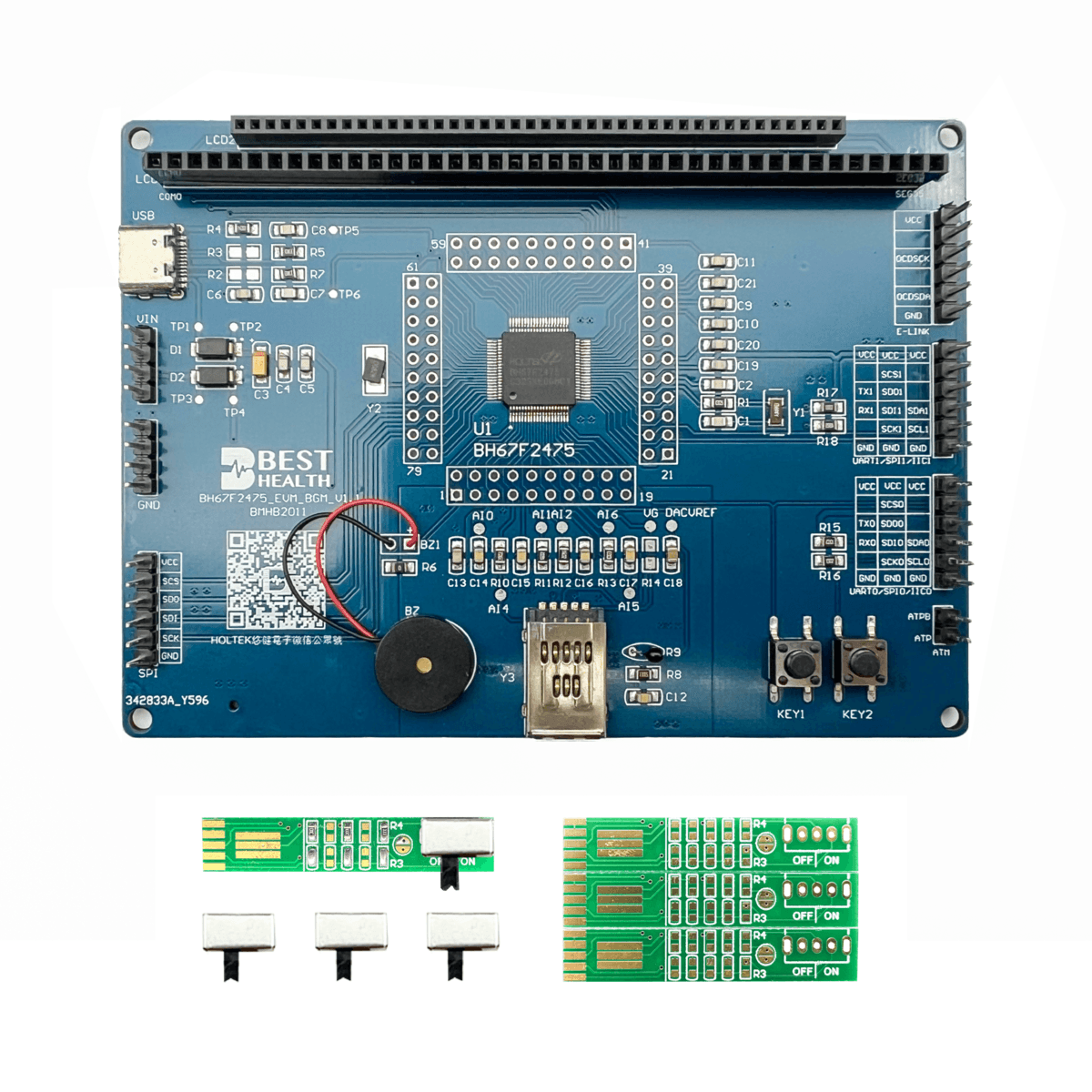
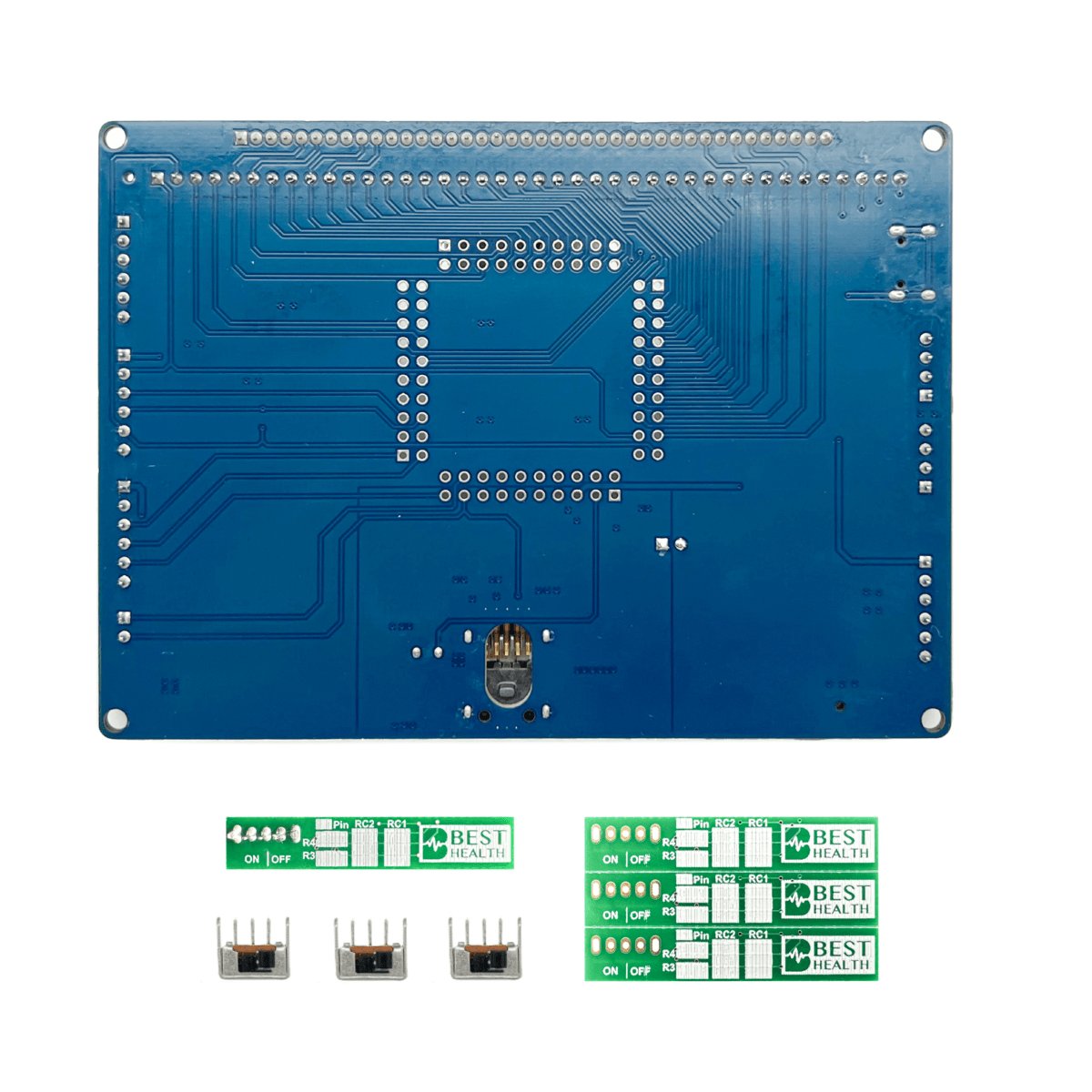
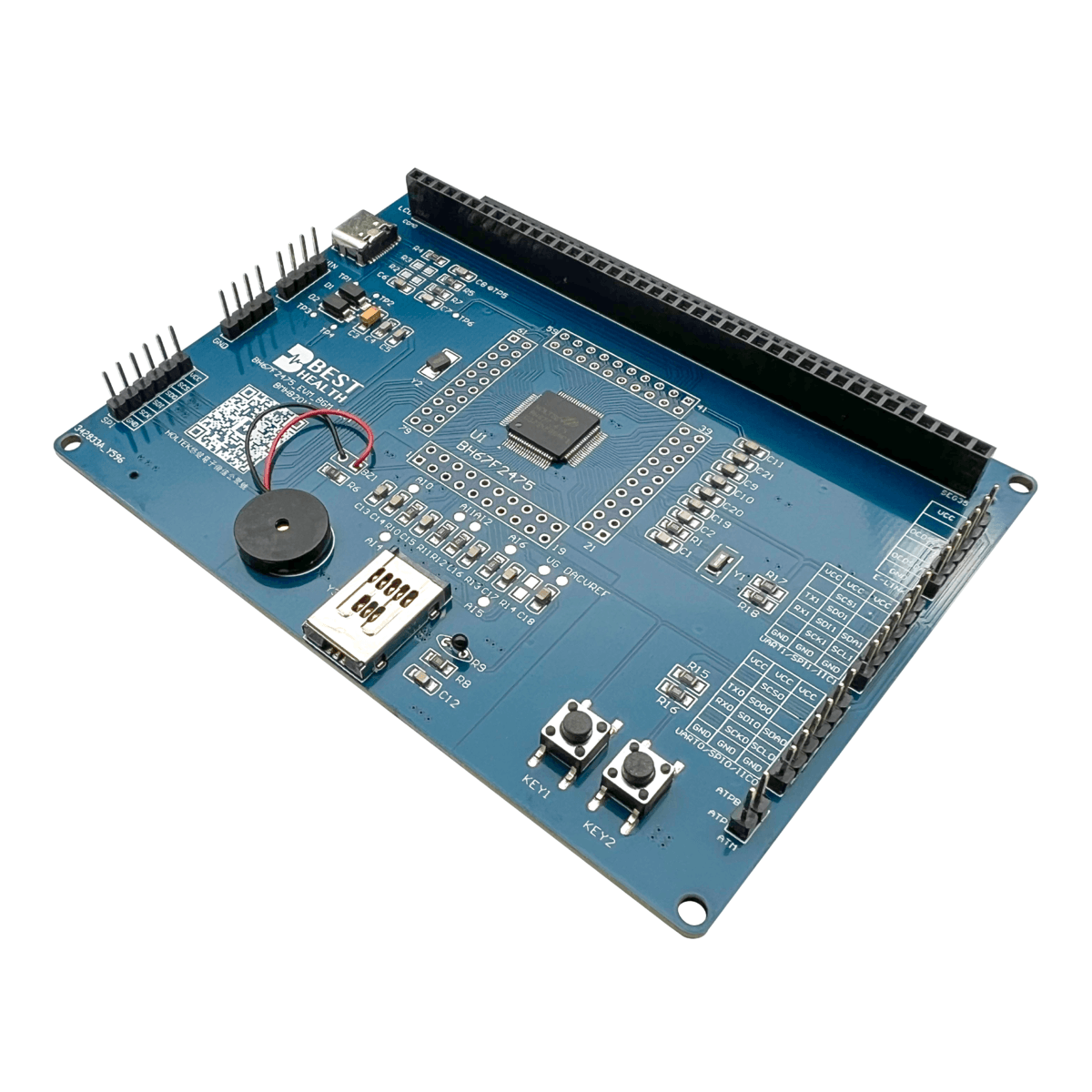
The BMHB2011 is the development board of BH67F2475. With it, you can evaluate the functionality of the MCU.

Online Shopping

Quick Start

BH67F2475 BGM Dev Board BMHB2011 — User Guide

Platform: BH67F2475 Version Date: 2026-06-10

The BH67F2475 is a Holtek Flash MCU designed for Blood Glucose Monitoring (BGM) applications, integrating a high-precision AFE, 12-bit ADC, LCD driver, EEPROM, UART, SPI, and I²C peripherals. The BMHB2011 dev board provides a complete driver library and hardware reference design for rapid evaluation and custom development.

1. Directory Layout
BH67F2475_EVM_BGM/
├── 1.doc/                    # Documents and references
├── 2.code/                   # Driver source code
│   └── BH67F2475_Driver/     # BH67F2475 driver
└── 3.board/                  # Board-level and PCB files
2. 1.doc — Documents and References

Contains the BH67F2475 datasheet and package drawings.

FileDescription
BH67F2475v150.pdfBH67F2475 English Datasheet (v1.50)
simBH67F2475v150.pdfBH67F2475 Chinese Datasheet (v1.50)

The datasheet is available in both Chinese (simBH67F2475v150.pdf) and English (BH67F2475v150.pdf).

3. 2.code — Driver Source Code

The BH67F2475 driver package includes low-level peripheral drivers, board configuration, and example projects.

3.1 Directory Overview
2.code/
└── BH67F2475_Driver/
    ├── BH67F2475.h            # Top-level header
    ├── board/                 # Board configuration (BoardCfg.h)
    ├── driver/                # Peripheral drivers (ADC12, AFE, EEPROM, I²C, SPI, UART, etc.)
    └── example/               # Example projects for each peripheral
3.2 Key Driver Modules
ModuleDescription
Afe.c / AfePower.hAFE analog front-end driver (core BGM signal acquisition)
Adc12.c12-bit ADC driver
Lcd.cLCD segment display driver
Eeprom.cEEPROM read/write driver
I2c.c / I2cMaster.cI²C master/slave driver
Spi.c / Spia.cSPI driver
Uart.cUART transceiver driver
Iap.cIAP in-application programming driver
PTM.c / STM.c / TimeBase.hTimer drivers
3.3 Build and Programming
  • Projects use Holtek's format (.pjtx / .OPT); use Holtek HT-IDE to build.
  • Refer to Holtek's BH67F2475 programming guide for flash download procedures.
4. 3.board — Board-Level and PCB Files
FileDescription
BH67F2475_EVM_BGM_V1.1.zipBMHB2011 BGM Dev Board V1.1 design pack (schematic, PCB, BOM)
5. Quick Start Guide
  1. Read the datasheet1.doc/BH67F2475v150.pdf (English) or 1.doc/simBH67F2475v150.pdf (Chinese)
  2. Review the hardware design — unzip 3.board/BH67F2475_EVM_BGM_V1.1.zip to view the schematic and PCB
  3. Get the driver — navigate to 2.code/BH67F2475_Driver/ and explore driver/ and example/
  4. Build an example — open an example project from example/ in Holtek HT-IDE and compile
  5. Flash and verify — follow Holtek's BH67F2475 programming guide to download firmware and validate on board
6. Version & Contact
7. Disclaimer

The materials in this repository — including hardware schematics, PCB files, source code, and documents — are provided solely for customer reference and evaluation. Before using these materials in product design, mass production, or commercial deployment, customers are responsible for conducting full functional testing, reliability validation, and regulatory certification. BestHealth Electronics Inc. (悠健电子(东莞)有限公司) shall not be liable for any direct or indirect losses arising from the customer's use of these materials in production, sale, or operation — including but not limited to yield issues, field failures, product recalls, or end-customer claims. These materials are provided "as is" without warranty of any kind, express or implied.

8. Intellectual Property

All materials in this repository (including but not limited to hardware design files, source code, documents, trademarks, and logos) are the intellectual property of BestHealth Electronics Inc. (悠健电子(东莞)有限公司), protected by applicable laws. Customers are granted only the right to use these materials for reference and evaluation. Reverse engineering, resale, redistribution, or unauthorized public release is prohibited without prior written consent.

© 2026 BestHealth Electronics Inc. (悠健电子(东莞)有限公司) All Rights Reserved.

This README is a directory-level user guide for fast navigation. Refer to the individual PDFs and source code for parameter and register details.

Complete Package

BMHB2011 Complete Resource Package

BH67F2475 BGM V1.1 Board Design

BH67F2475 Driver Source Code

🔬 Development Stage

Tools for development and debugging

💻 Software

IDE-3000

(IDE Software)

The HT-IDE3000 is a simulation software specially developed for HOLTEK 8-bit MCUs. When used together with OCDS EV chip, it will implement a series of operations such as single step, full speed, breakpoint setting, RAM monitor, etc.

Documents

IDE-3000

The HT-IDE3000 is a simulation software specially developed for HOLTEK 8-bit MCUs. When used together with OCDS EV chip, it will implement a series of operations such as single step, full speed, breakpoint setting, RAM monitor, etc.

HT-IDE3000 User’s Guide

🔧 Hardware

e-LinkPro2

(Debug Hardware)

The e-LinkPro2 function is compatible with the e-Link and which is an online debug adaptor for Holtek's new generation of OCDS architecture Flash MCUs. Together with the HT-IDE3000 software it allows users to program and debug programs on their target boards. The e-LinkPro2 also provides an ICP function for Flash MCUs. When connected to a PC and when used together with the HOPE3000 software the e-LinkPro2 can also be used as a low volume engineering programmer for HT8 Flash MCUs.

Documents

Holtek e-Link for 8-bit MCU OCDS User’s Guide

🏭 Small-scale Production

Tools for small batch programming

💻 Software

IDE-3000

(IDE Software)

The HT-IDE3000 is a simulation software specially developed for HOLTEK 8-bit MCUs. When used together with OCDS EV chip, it will implement a series of operations such as single step, full speed, breakpoint setting, RAM monitor, etc.

Documents

IDE-3000

The HT-IDE3000 is a simulation software specially developed for HOLTEK 8-bit MCUs. When used together with OCDS EV chip, it will implement a series of operations such as single step, full speed, breakpoint setting, RAM monitor, etc.

HT-IDE3000 User’s Guide

HOPE5000

(Programming Software)

The HOPE5000 is a software designed by Holtek for programming MCUs. The software is connected to the writer via a USB cable to transmit the related programming data.

Documents

HOPE5000

The HOPE5000 is a software designed by Holtek for programming MCUs. The software is connected to the writer via a USB cable to transmit the related programming data.

HOPE5000 User guide

🔧 Hardware

e-Socket

(Programming Hardware)

The e-Socket is a socket which is used together with e-WriterPro. MCUs with the same package types can use the same e-Socket for programming. It is not necessary to purchase individual programming adaptors for different MCUs. The e-Socket is designed with a programming counter which enables the e-WriterPro to remind users when to replace the e-Socket with a new one after a certain amount of times. This function is provided to maintain high programming quality.

e-WriterPro2

(Programming Hardware)

The e-WriterPro2 is an upgraded version programmer of the e-WriterPro, which is fully compatible with the previous version, and it can be used not only as a programming tool for all of Holtek’s OTP and Flash devices during development stage but can also be used for small to medium volume production purposes.

🏢 Mass Production

Tools for high-volume manufacturing

💻 Software

IDE-3000

(IDE Software)

The HT-IDE3000 is a simulation software specially developed for HOLTEK 8-bit MCUs. When used together with OCDS EV chip, it will implement a series of operations such as single step, full speed, breakpoint setting, RAM monitor, etc.

Documents

IDE-3000

The HT-IDE3000 is a simulation software specially developed for HOLTEK 8-bit MCUs. When used together with OCDS EV chip, it will implement a series of operations such as single step, full speed, breakpoint setting, RAM monitor, etc.

HT-IDE3000 User’s Guide

🔧 Hardware

GangWriter00-8

(Programming Hardware)

The product is an upgraded gang programmer of Gang-Writer32-8 and Gang-Writer8-8. It is composed of a development board and two programming modules and supports programming both Holtek 8-bit and 32-bit MCUs. Each programming module includes 4 programming interfaces, and one development board can connect up to 4 programming modules. This allows the product to program up to 16 MCUs simultaneously, with support for parallel programming across 2, 4, 6, 8, 12, and 16 sites.

e-Socket

(Programming Hardware)

The e-Socket is a socket which is used together with e-WriterPro. MCUs with the same package types can use the same e-Socket for programming. It is not necessary to purchase individual programming adaptors for different MCUs. The e-Socket is designed with a programming counter which enables the e-WriterPro to remind users when to replace the e-Socket with a new one after a certain amount of times. This function is provided to maintain high programming quality.

e-WriterPro2

(Programming Hardware)

The e-WriterPro2 is an upgraded version programmer of the e-WriterPro, which is fully compatible with the previous version, and it can be used not only as a programming tool for all of Holtek’s OTP and Flash devices during development stage but can also be used for small to medium volume production purposes.

Follow Our WeChat
Scan QR code to follow us on WeChat

Scan QR code to follow us on WeChat

+86-769-26261311info@e-besthealth.com